Nov 9, 2010

The 50 Best Films of the 2000s: Numbers 30-11

30. Brand Upon the Brain! (d. Guy Maddin, USA/Canada, 2007) Maddin is as much a collage artist as a filmmaker, picking and choosing from a mad collection of sources—the history of cinema, pulp novels, his own memory, bizarre images that may have been glimpsed in a nightmare—and making something totally, invigoratingly, frighteningly new. Contradictions abound, as they do in a dream or a memory: his movies are frightening and silly, singular and allusive, mad and understated, filled with pulpy stories and abstract non-narratives. Quite simply, there's no one else making movies like him, and there never really has been—but distinctiveness is not his only, or even his foremost, quality.

Marcel Proust may seem like an absurd comparison to Maddin, but both the writer and the filmmaker spring forth from their own hazy memories, creating something operatic and highly formalized from the interweaved fabric of their pasts. Even though the plot of Brand Upon the Brain! involves a demented mad scientist performing midnight experiments, an orphanage run from a lighthouse that offers mysteries such as the disappearance of a boy named Savage Tom and bizarre drillholes in orphans' heads, a brother-sister detective duo known as the Light Bulb Kids, cross-dressing and ambiguous sexuality, mother-daughter sexual antagonism, and other oddities, Maddin still insists that 96% of the movie is accurately drawn from his own childhood. Figuratively speaking, that's actually easy to believe; this deranged world must be forged from some very troublesome and intimate memories, wedded to an absolutely unique artistic mindset.

Shot on archaic-looking black-and-white film (with some sporadic sparks of color) and edited together in a jagged, schizophrenic manner, the movie is exhilarating in a purely formal sense; even its intertitles, which are meant to both embrace and send up the hyperbolic storytelling styles of 1920s silent cinema, are highly entertaining in their mixture of postmodern irony and cinephiliac enthusiasm. But Maddin's movies are not just indulgences in postmodern tomfoolery; considering how amusing his films are, it's surprising how genuinely frightening, unsettling, and emotional they remain, especially in Brand Upon the Brain! and Cowards Bend the Knee. Watching something like this is like flipping kinetically through Maddin's family photo albums, but the pictures seem to have been recorded in some other alternate dimension.

29. Wendy and Lucy (d. Kelly Reichardt, USA, 2008) Deceptively simple, Wendy and Lucy is unquestionably one of the saddest movies made in the last ten years, but it also may be the one that most ably encapsulates how this country's recent economic hardships have affected the lives of individuals. Michelle Williams gives a flawless performance as Wendy, a young woman trying to travel to Alaska, where a lucrative job awaits, with her beloved dog. She has planned her funds carefully; she has just enough money to make it to her destination. So when her car breaks down en route, her dire economic straits force her into a series of increasingly difficult decisions. The underlying, and painfully relatable, truth: our relationships with those we love should not be endangered by poverty, but sometimes they are; money should not be a greater priority than happiness and togetherness, but sometimes, due to external circumstances that we cannot change, this is the case.

Much of the movie is understated—the most hopeful moment, for example, is a brief interaction in which a kindly security guard covertly loans Wendy a few dollars from his own minimal savings, which we come to recognize as a magnanimous self-sacrifice—but it doesn't seem accurate to call the movie “quiet.” Its compassion towards Wendy and Lucy, her dog, is painfully sincere; its bitterness towards the kind of world where money dictates our behavior and our relationships is palpable, and justified. This passionate, humane outrage, which culminates in an astonishingly bittersweet final scene, leaves you staggering by the time the movie ends.

28. Bright Leaves (d. Ross McElwee, USA/UK, 2004) The director of Sherman's March again creates a compelling, free-flowing mosaic that simultaneously explores his family legacy, the history of the American South, the role that cinema plays in our lives, and other fascinating tangents. Watching this gorgeous, stimulating movie, I kept thinking about Chris Marker's Sans soleil (1983)—one of my favorite movies, and one in which any jumble of interrelated topics that appeal to Marker at any specific point in time will become the new subject of his documentary. I like documentaries like this: the truth about any particular subject can never really be exhausted, especially not in a medium as subjective as cinema, so I usually find it more compelling when directors use the documentary format to ruminate about a number of challenging ideas, posing questions instead of offering answers.

But whereas Marker remains a cypher in Sans soleil and most of his movies (we never get a sense of the director as a flesh-and-blood character), McElwee's movies are primarily about his own life, his own history. Even when he originates with a specific historical topic, as in Sherman's March, the subjects very quickly begin to center around McElwee's life history, his family, their troubles. Bright Leaves, for example, is broadly about the tobacco industry in North Carolina, but this subject appeals to McElwee because his great-grandfather, John McElwee, was one of the titans who gave birth to that industry. Creator of the Bull Durham line of tobacco, John McElwee's career was essentially destroyed by his rival, James Buchanan Duke—founder of the Duke dynasty. This rivalry, McElwee hypothesizes (after being convinced by a second cousin), was in fact the inspiration for the 1950 film Bright Leaf, starring Gary Cooper and Patricia Neal. The tangents and subtopics branch out compellingly from there, but the central glue that ties it all together is McElwee's family and their close connection to the world in which they grew up.

Ross McElwee displays wit and self-reflexivity in amusingly subdued ways—for example, in his inclusion of dialogue scenes that show him debating how he should film the following scene, or in musing about the filmmaking process while constantly emphasizing himself as a creator who works at the behest of chance, luck, and whatever the world around him has to offer. The movie is meta, then, but for a reason: McElwee reminds us that—for all of us, not just for this passionate filmmaker—cinema plays an integral role in fashioning the myths and half-formed truths by which we lead our lives, ultimately becoming an addiction not unlike the cigarettes that built North Carolina's economy and endangered the well-being of McElwee's family.

27. Up (d. Pete Docter & Bob Peterson, USA, 2009) I will always remember Up as the movie that had me bawling before a stone-faced five-year-old who was staring at me intently, sitting on her mother's lap in the row in front of me; I will remember it, also, as a movie that could take you from that place of intense sadness to euphoric highs that practically sent you sailing from the theatre.

We should have known by now that Pixar's incredible winning streak was no fluke, that they kept on making one incredible movie after another not because they were lucky but because they are probably the best storytellers and stylists working in American film today. But many people still seemed wary, expecting them to fail spectacularly at some point. After seeing Wall-E, I found myself having similar doubts, especially when I heard that Up was coming out less than a year afterwards—one masterpiece couldn't possibly be followed up by another, could it?

My doubts were foolish. The makers of Up are so profoundly in love with the life experience, and so obviously compassionate towards the worlds and characters that they create, that we can't help but be affected by what happens as though they were occurring in our own lives. (This is why the emotional states that I mentioned before are so overwhelming: the pain is our pain, the joy ours' too.) This incredible sensitivity is mixed with a wild storyline that has an elderly widower and a fresh-faced eight-year-old Cub Scout careening to South America on a balloon-equipped house, ultimately finding talking birds and a nefarious plot conducted by a hermetic villain. The unusual plot and beautifully maintained pathos do not contradict each other; in fact, the unexpected twists and turns in the story turn out to provide the perfect outlet for the movie's themes on loneliness, companionship, adventure, and a sense of fulfillment.

It may seem hyperbolic to claim that Up's predominant theme is the entirety of human life, and even more so that it satisfies the complexity of this theme; but astonishingly, I would say that this is close to being true. Childhood, love, marriage, parenthood, friendship, aging, lost dreams, death—these are all conveyed with intense sympathy by Up. This is why the movie makes you feel overjoyed about living, even when it makes you feel life's intense pain as well.

26. Cure (d. Kiyoshi Kurosawa, Japan, 2001) Kurosawa's slow-burn brand of horror is epitomized by Cure, a difficult and hypnotic chiller that offers no easy answers. A series of bizarre murders are committed in Tokyo in which each apparent killer is a normal, mild-mannered, everyday person who carves into their victims a sinister “X.” The only connection shared by these unfortunate murderers is that, shortly before their crimes, they came in contact with “Mr. Mamiya,” a mysterious cypher with a sinister history in hypnosis.

This story makes for awesomely ominous serial-killer fodder, and Kurosawa satisfies the creepy potential of this setup. The horrific home of Mr. Mamiya, for example, is every bit as creepy as Buffalo Bill's mannequin-laden lair in Silence of the Lambs, and the numerous interactions between Mamiya and our detective hero, Takabe, are almost unbearably intense, filmed as they are in Kurosawa's distinctly removed, often static aesthetic. But ultimately, Kurosawa is more concerned with theorizing about the nature of evil than simply providing a good genre picture. All of the everyday people who become murderers in Cure are saintly, noble folks, almost to the point of parody; Takabe himself, for example, sacrifices himself to care for his wife, whose sanity is quickly deteriorating. A significant point to the movie is that we begin to see Takabe unravel far before he even comes in contact with Mamiya. The underlying idea is that good and evil are separated only by the thinnest of threads, and that one can topple over into the other with alarming abruptness. This theme takes on even greater power when we recognize that Japan's recent J-horror trend in film reflects a largely unexplained rise in violent crime committed in Japan's urban areas over the last decade; what could contribute to such a violent plague?

Cure is probably Kurosawa's most cryptic and disturbing movie, especially thanks to its staggeringly bizarre ending. Many have criticized the last half-hour of the movie as being too slow, too difficult, too confusing, which would be a valid criticism if Cure were only concerned with providing a good story with a neat resolution. But its climax and ending make it apparent that the movie is trying to unsettle us with its narrative as much as its characters are unsettled with their inexplicably gruesome actions. Ultimately, as seems to be true in real life, the sudden transformation from good into evil cannot be explained; it can only be fleetingly, disturbingly witnessed.

25. Silent Light (d. Carlos Reygadas, Mexico/France/ Netherlands/Germany, 2009) The opening and closing shots of Silent Light are miraculous: beautiful night photography records the long journey of darkness into dawn for the opening shot, and for the final image, the pattern is reversed—the magnificent colors of twilight are embraced as day fades into night. Both shots take several minutes, as the shot arcs gracefully through the sky. Even if you've seen a sunrise or sunset (which we all have), the images still seem totally new, something that only cinema can accomplish.

This description could apply to much of Carlos Reygadas' filmmaking. One of the most austere and provocative arthouse directors working today, his movies include Japon (2002) and Battle in Heaven (2005), both of which feature explicit sex and nudity, incredibly long, often static shots of either the horror or wonder of nature, and bare storylines that are meant to evoke the profound ethical confusion of the human experience—the lack of a definitive moral code that tells us what is right and what is wrong.

Silent Light is a departure from these two movies in some ways. There is no onscreen sex or nudity, for example, and the setting is totally different than almost any movie that's been made before: Silent Light is filmed in a remote Mennonite community in Mexico, using non-professional actors who actually live within that sect. (Even the language spoken in the movie—a Germanic dialect called Plautdietsch—has reportedly never been heard in a film before.) But in other ways, Silent Light absolutely abides by Reygadas' stylistic and philosophical interests: its cinematography is stark and breathtakingly beautiful, and its characters are still tempted by passions and loves that they know are “wrong,” which forces them to make decisions that harshly reveal the painful confusion of living a human life.

The two main characters are Johan and Marianne, who are carrying on an affair even though both of them are married. Maybe in most modern communities this would be an unspectacular story, but in this austere and close-knit community, this affair is absolutely a betrayal of these characters' ideals. However, there is real love involved between them, and Johan has already confessed this affair to much of his family, including his wife Esther, who resignedly accepts this fact while continuing to love her husband. There are no tearful arguments between loved ones, no grand confessions; there is primarily great inner turmoil that centers around the rift between one's faith and one's natural human desires, between a self-imposed moral code and a passion that is impossible to resist.

I've grown tired with a lot of movies that have recently come out on the international arthouse scene: while I used to respect practically any movie that offered a stark, austere aesthetic, a somewhat abstract narrative, and muted performances meant to convey inner pain, I've since recognized that this mode of filmmaking can in fact lazily disguise a lack of any profound ideas with a style often unquestionably referred to as “artful.” But Reygadas continues to fascinate; his gruelingly long takes and intensely muted atmosphere try to get at some deeper human pain, and do achieve a profound beauty. He embraces the arthouse legacy that was originally conceived by mentors such as Carl Theodor Dreyer and Andrei Tarkovsky. The style of Silent Light is meant to reflect the solemn moral code by which its Mennonite community lives: in both cases, great passion and pain lurk beneath the surface.

24. There Will Be Blood (d. Paul Thomas Anderson, USA, 2007) There Will Be Blood really does seem like nothing that's been made in Hollywood before (or maybe even on the American independent scene); its closest antecedent may be Robert Altman's McCabe & Mrs. Miller (1971), but only in the vaguest genealogical way. Anderson's movie is an adaptation of Oil!, the Upton Sinclair novel, that only uses the first 150 pages as a springboard; it's an allegorical portrayal of the war between modern capitalism and institutionalized religion that exposes how the two may be more closely linked than separated; it's a cryptic horror movie about murder and evil and being torn apart from within; it's absurd and brazen and funny and heartbreaking.

Daniel Day Lewis gives maybe the most singular performance I can think of in any movie over the last decade as Daniel Plainview, a formidable big-oil man in the early twentieth century who destroys those around him in his quest to own everything within his grasp, people included. Paul Dano, who deserves commendation for being able to stand his own against Lewis' titanic performance, is a pair of identical twin brothers—one of whom, a manipulative evangelist, stands in the way of Plainview's empire. The focus of the movie is actually quite concentrated, mostly taking place in the barren fields of Texas at the heart of Plainview's oil operation; but the movie still feels epic in scope and majestic in execution, thanks largely to Anderson's distinct and intuitive aesthetic.

To call the movie a triumph of style over substance (as some critics did) is to miss the ways in which Anderson absurdly hyperbolizes Plainview's loneliness and desperation. Yes, so much of the movie is brilliantly over-the-top: the famous milkshake speech (which was partially based on actual Congressional transcripts from big business trials in the 1920s), Plainview's humiliating beating of Paul Sunday followed by Sunday's humiliation of Plainview in his church, Plainview's vicious castigation of a businessman while dining with his son in a restaurant, and Paul Sunday's ultimate fate are all grandly evoked, but they all also center around Plainview's realization that his fierce ambition will always outweigh and eventually obliterate his relationships with those around him. You could say, then, that both There Will Be Blood and Anderson's earlier Magnolia are operatic epics, but whereas the latter is exhausting and somewhat more of a stylistic prank than an effective drama, There Will Be Blood is as awe-inspiring in its characterizations as in its visual majesty.

23. The New World (d. Terrence Malick, USA/UK, 2005) How can you capture the discovery and exploration of a totally new world on film? Such a film would require euphoria and terror, awe and loneliness, exoticism and intimate beauty. Some movies have succeeded at this daunting task: we may think of the moment in which T.E. Lawrence first appears through a desert haze in Lawrence of Arabia, or the sense of splendor that runs throughout Werner Herzog's Encounters at the End of the World. But The New World is perhaps the only movie I've seen that maintains this sense of awe throughout its entire (lengthy) running time; as the film plays out before you, you really do feel like you're being guided through uncharted territory.

It may be little surprise that Terrence Malick is responsible for such an overwhelming achievement. Maybe the most sensitive stylist in the history of American movies, Malick's filmmaking is always beautiful, but that beauty is meant to manifest some deeper emotion: longing, love, passion, heartache. There's plenty of the above in The New World, which is basically a retelling of the well-known Pocahontas tale. This is no Disney movie, though. Malick's film is more specifically about the birth of this country, the seemingly limitless potential of this beautiful untouched land at its origins, and how quickly that potential was besmirched by the colonial mindset of entitlement and Manifest Destiny. Love and loss, indeed; the classic tragic-lovers tale of Pocahontas and settler John Smith is paralleled to the rapture and violence that accompanied the arrival of European explorers in this country. This is why The New World can simultaneously seem so majestic and epic, and yet essentially is an intimate look at individual people who find themselves lost in an overwhelming world.

Not unlike Herzog in many of his movies, Malick is concerned with how the natural beauty of this world may be ruined by the greed, ambition, and folly of man. He's not unwilling to see some aspects of human civilization as majestic, as is evidenced by Pocahontas' initial journey to England late in the film (her introduction to a new world is almost as rhapsodic as John Smith's introduction to America earlier on); but for the most part, the visual splendor of The New World is meant to remind us of how this country's edenic nature no longer exists.

The movie is not without flaws; Malick romanticizes the native American Indian population unabashedly, which sometimes turns the movie into a simplistic indulgence in exoticism not unlike Dances with Wolves. But even during these weaker moments, The New World achieves a poetry uncommon in any kind of cinema. Malick and his cast are sensitive and smart enough to turn some sappy, wooden dialogue (“He is like a tree, he shelters me,” says Pocahontas of one character) into a solemn trance of sorts—intoning words of love and desire while the camera evokes likeminded images. This is the kind of movie you get lost in, becoming hypnotized by its images and thirsting for more.

22. Into Great Silence (d. Philip Gröning, France/Switzerland/ Germany, 2007) I saw Into Great Silence at the Times Cinema in Milwaukee back when it still catered to foreign/arthouse films and retrospectives of classics, all on 35mm. Since I had no car at the time, I had to venture practically all the way from the east to the west side of Milwaukee on the bus, then walk an additional fifteen minutes or so to the theatre from the bus stop on Vliet St. (This may mean little to non-Milwaukeeans, but for me, and maybe for other folks who have undertaken a similar crosstown journey to see a movie, the half-invigorating, half-tedious memories are flooding back.) It was, therefore, an hour-long trek to see this lengthy documentary about the Grande Chartreuse, a 900-year-old-plus Carthusian monastery hidden in the French Alps. Turns out such a heavy investment in moviegoing befits a film as momentous as Into Great Silence.

Director Gröning wrote the monks of the Grande Chartreuse in 1984 asking for permission to film there. Because they are among the most ascetic order in the world, it took the monks of the Grande Chartreuse sixteen years to give him permission to do so, and even then only with strong restrictions: Gröning could use no voiceover narration and no artificial lighting, and he was not allowed to bring a crew along with him—Gröning himself was the cinematographer and sound-man.

I don't know if Gröning would have decided upon a similar aesthetic regardless, but this stripped-down style is entirely appropriate for Into Great Silence. We simply observe the monks of the Grande Chartreuse, going about their everyday lives. These lives involve the sort of religious austerity that we may have predicted—chanting, praying, studying scripture, and so on—but they also include a great deal of levity and immediate pleasure—going sledding, enjoying an orange in a sunlit garden, etcetera. This makes Into Great Silence not so much about a specific religious institution, but about joy and spirituality and its ubiquity in the world. It may sound like poetic naivete to say that one can find God in an act as simple as sledding in the sunlight or in peeling an orange, but this seems almost incontrovertible, given all the simple and joyous beauty that this movie has to offer.

There is a certain ethnographic pleasure to be gained by the movie: we are granted access, for 165 minutes, to a sealed-off world of rigorous simplicity that we would otherwise never know. In some other ways, though, Into Great Silence offers an immediate connection to our own lives, reminding us that divinity and bliss need not be confined to the pages of the Bible or the walls of a church. This is why my hours-long voyage to and from the west side of Milwaukee to see Into Great Silence was so appropriate: waiting for the bus in twenty-degree weather with the lights of downtown in the distance, everything, after watching this movie, seemed full of majesty.

21. A Christmas Tale (d. Arnaud Desplechin, France, 2008) How do you describe an Arnaud Desplechin movie? Part screwball comedy, part operatic tragedy, teeming with both self-reflexivity and genuine melodrama, bounding with allusions to existentialist philosophy, Renaissance painting, hip-hop music, and other cultural artifacts, Desplechin's movies resemble what may have been the result if a dozen disparate and unique directors from the history of film collaborated on a single madcap epic. No surprise that his movies are usually marked by two-and-a-half-hour-plus running times, then.

Like Kings and Queen before it (and, to a lesser extent, like Desplechin's My Sex Life...Or How I Got into an Argument), A Christmas Tale is about a dysfunctional family, the bombastic personalities that comprise it, and the struggle it faces to remain connected. A Christmas Tale in particular takes place around the titular holiday, as the matriarch (played inimitably by Catherine Deneuve) discovers she needs a bone marrow transplant to battle her liver cancer and must turn to her family for a donor. If this synopsis sounds like a million other happy-sad yuletide family dramas, you will be bewildered by the movie itself. (Even if you have no idea what to expect from the movie going in, you will probably be bewildered—I absolutely was, wonderfully so.) It's as though Desplechin is using this cliched setup not only to poke into the most interesting nooks and crannies of these characters—relying upon teary-eyed confrontations as well as the most unexpected and fleeting moments between them—but also to indulge in his stylistic and metacinematic inclinations. He uses the story as a springboard to dabble in the limitless tricks and narrative devices available to the filmmaker, nodding reverentially towards a history of wildly diverse cinema.

This appraisal may make A Christmas Tale sound like hollow showboating, but there's definitely nothing hollow about Desplechin's movie. Just because the film isn't conventionally melodramatic doesn't mean it's not emotional. The unpredictable glimpses we are offered into the characters' lives—a live DJ performance that comes out of nowhere, or a glance shared between a husband and wife after a bittersweet development that seems to speak pages of dialogue in a few seconds—turn the Vuillard family into a brightly-colored tapestry in increasing danger of ripping each other apart. (Paradoxically, the intense relationships among this family are also what keep them so intimately connected, as Desplechin reminds us that love and hatred are flip sides of the same coin, separated only by the thinnest of boundaries.) The movie may not be as emotional as Desplechin's prior Kings and Queen, but it comes close (and both of them are among the most striking comedy-drama-whatevers of the last ten years).

The incredibly complex backstory of this family resembles some Dickensian epic, as it contains siblings who died in their youth, economic swindles, banishments, suppressed lust and longing, and other tragedies. Heavy as much of this plot is, though, the main feeling we experience while watching A Christmas Tale is euphoria, excitement, a giddy anticipation of what is going to happen next. His panoply of styles and moods is doubtlessly overwhelming, but it leaves you with a satisfying fatigue, like coming down off of a high or waking up the day after Christmas with a magnificent hangover.
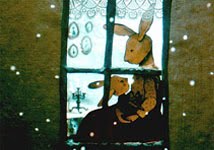
20. The Hedge of Thorns (d. Anita Killi, Norway, 2003) At 13 minutes, The Hedge of Thorns contains more visual poetry and overwhelming sadness than most feature-length dramas. Gorgeously animated in a languid stop-motion style not unlike (and, for what it tries to achieve, superior to) Fantastic Mr. Fox's, Killi's film is about two neighbors, a young boy and girl who play together almost every day in the snowy plains between their homes. When World War II encroaches upon their world, though, tensions rise and a protective barrier is built between the two families (the titular hedge of thorns), separating boy and girl until years later, when the war has ended. That the ending is an impassioned tearjerker is not all that surprising, considering that The Hedge of Thorns is an unabashed antiwar movie (made during the initial years of the War in Iraq). What is surprising is how effective and genuine its sentiment is, achieving profoundness through understatement and simplicity rather than moralistic showboating.

Several movies in the past have tried to decry war by filtering it through the innocent worldview of children—for example, René Clément's Forbidden Games (1952) and Isao Takahata's Grave of the Fireflies (1988). The latter is actually a perfect point of comparison for Killi's short: both masterpieces of animation and pathos, The Hedge of Thorns and Grave of the Fireflies are able to evoke astonishing pain and loss through their young characters. Most war movies—even (or especially) those which claim to be antiwar—in fact have clear-cut heroes and villains, portray combat in a viscerally exciting way, and concentrate more on the valor of soldiers than on the violence and loss experienced by civilians. The Hedge of Thorns, with bitter succinctness, makes us feel the destruction, physical and otherwise, that war instills.

I saw The Hedge of Thorns in 2003 at a film festival for children held in and around Milwaukee, where I was volunteering as a projectionist and subtitle-reader (the festival unfortunately no longer exists). Seeing the movie for the first time (while simultaneously reading its subtitles to the audience) surrounded by young children and their families who were obviously as affected as I was, I realized how often critics and filmmakers underestimate the intelligence and sensitivity of young audiences. I thoroughly enjoy the insanity and creativity of many children's movies, but I wish more of them attempted the sincere message of peace and loss that The Hedge of Thorns accomplishes (as do Up and Wall-E), and took place in a world that had some bearing on our own reality. I've tried to find Killi's film since then online or through the production company, but—in a fate common to many international short films—it now seems unavailable except on DVD through the Norwegian Film Institute. However, a representative clip from the film can be viewed online here:

http://www.trollfilm.no/new/eng_torne_1.html

19. Café Lumière (d. Hou Hsiao-hsien, Japan/Taiwan, 2005) J. Hoberman calls Café Lumière “exquisitely understated,” which itself seems like an understatement. Directed by the Taiwanese master Hou Hsiao-hsien—whose movies are distinguished by an incredibly tranquil (some would simply say boring) pace, a typically stationary camera that observes scenes play out, a melancholy love for his homeland and ambivalent observation of its transformation into modernity, and incredibly subtle social commentary that depends upon at least some prior knowledge of Taiwanese culture, politics, and history—Café Lumière is decidedly for those viewers who like to disappear into the movies they watch, get lost in them, spend time with the images they offer to us. Patience is required, but once you let yourself sink into the movie's beauty, boredom is the last thing on your mind.

Café Lumière is Hou's homage to the Japanese director Yasujiro Ozu, commissioned in honor of Ozu's 100th birthday. The two directors are akin in many ways—Ozu shares many of the stylistic and thematic preoccupations I mentioned above, although he integrated them a bit more evenly into a studio style and a narrative format—but Hou is able to attempt an even more languid, reverential style that Ozu, as a contract director, was not exactly free to indulge in (even if he had wanted to). Of course, too, Café Lumière observes the technological and sociocultural shifts of modern capitalism in the latter half of the twentieth century, which Ozu (who passed away in 1963) was unable to do. (One imagines, though, that if Ozu had lived to see the new millennium and made films about the transformation, the result may have been pretty close to Café Lumière—see Ozu's masterful 1959 satire Good Morning as an example of his bemused interest in modern technology.)

The main character is Yoko, a Japanese woman who has just returned to Tokyo after a stay in Taiwan. We observe her wandering throughout the city, snapping pictures and conducting research for a project about twentieth-century Chinese composer Jiang Wenye, whose music acts as the movie's soundtrack. This being said, though, Café Lumière doesn't exactly have a plot. We observe characters eating meals and watching the metropolis around them, sometimes in frustration, sometimes in awe. The whole movie can be summarized as a testament to observation, to listening as well as watching: while the patient cinematography and the title's homage to one of the founders of cinema point to a fascination with sight, a minor character—a bookstore clerk named Hajime who pines for Yoko and who spends his free time recording the sounds of Tokyo for his computer-created artwork—equally respects the act of listening.

Hajime's use of his computer to create art, his digital recorder to capture sounds, and a camcorder to capture images—not to mention Yoko's use of numerous technological apparatuses to conduct her research, or Hou's beautiful, almost-abstract compositions of Tokyo's train system—indicate Café Lumière's multifaceted view of modern technology. It's a standby of modern arthouse cinema to portray technology as a deadening force, suppressing communication and alienating urban populations. While this theme is somewhat understandable in recent Southeast Asian cinema, given the turbulent sociocultural shifts that have been experienced in that region over the last several decades, the reality seems more shaded than that: technology can also connect people, can create beauty and art, can forge a more intimate connection between individuals and cities rather than a pronounced distance. Hou is sensitive to this tricky relationship between people, their cities, and their technologies; Café Lumière is enraptured by these relationships as well as, sometimes, dismayed by them.

I consider myself a city-lover—I can't imagine myself settling down outside of a metropolis—so to see the beauty and joy of modern city life so calmly captured by Hou (along with its frustrations and difficulties) is a wonder to behold. Like the aforementioned Into Great Silence, Café Lumière will leave you giddy about something as simple as walking around outside when the movie is over—taking in sights and sounds which suddenly seem so quietly majestic.

18. Golden Door (d. Emanuele Crialese, Italy/France, 2007) Deftly interweaving somber realism and fantastical surrealism, Golden Door turns its dual filmmaking styles into a metaphor for the immense migration of Europeans to the United States in the early twentieth century. The commingling of cold reality with bewitching superstition represents the rift between the Old World and the New: the movie opens with a visit to a witch in the Italian countryside convinced that a young pregnant woman must be exorcised of demonic snakes within her belly, but this scene could not be more different than those set at Ellis Island later in the film, in which immigrants new to this country are detained by an infinite amount of red tape and modern bureaucracy.

Golden Door ably evokes the claustrophobia, grime, disappointment, and heartache of the voyage to America, but impressively, it also conveys the hope, expectation, and electrifying uncertainty that accompanied it. The sporadic dream sequences that arise out of the characters' fraught states of mind are not just brightly-colored distractions meant to alleviate the film's bleakness; suggesting the extent to which desperate individuals rely upon their own fantasies for hope, such scenes in Golden Door underline the drastic gap between the American myth of open arms for all foreign peoples (represented by Lady Liberty herself) and the actual experience that such immigrants underwent.

For all of this, and considering how unsettling are the movie's scenes of foreigners being randomly married off to American suitors, Golden Door contains a great deal of joy and sweetness. This is primarily thanks to a tenuous central relationship between an Italian immigrant named Amato and a bourgeois woman played by Charlotte Gainsbourg, who, having just been jilted by her lover, depends upon Amato for admittance into the United States. Their rapport together is not the stuff of romantic comedy—meaning there's no grandiose union at the end of the movie—but it's enough to make Golden Door a movie of bewitching contradictions: real and dreamlike, sweet and somber.

17. Crimson Gold (d. Jafar Panahi, Iran, 2004) Jafar Panahi is one of modern cinema's most potent realists; here, working from a script by the equally great Abbas Kiarostami, he creates an unforgettable movie not only about class stratification in modern Iran, but about impoverished people living throughout the world, eager to change their lives for the better but often given scant opportunity to do so. Essentially, the movie is about the robbery of a jewelry store, but to label it such is to ignore what it's really concerned with. The narrative structure—presumably conceived by Kiarostami and perfectly constructed by Panahi—makes us aware of the inevitability of the movie's events before they happen, then circuitously doubles back and shows us the circumstances out of which this tragedy arose.

Wielding a slow, quietly-unfolding aesthetic familiar from Kiarostami's filmmaking, Crimson Gold gains tremendous power from the lead performance of Hussein Emadeddin, playing a Tehran pizza delivery driver. Large, stocky, often blank-faced, Hussein (the character and the actor) seems to coast through the movie, impelled by external forces but rarely taking any initiative of his own—that is, at least, until the desperate moments that open and close the film. We realize by the end that Hussein is not actually blankly wandering through a world that does not affect him; he is observing and internalizing, and ultimately decides that the only action he can take is a foolish and drastic one.

Panahi's previous movie, The Circle (2001—also excellent), is about the plight of single women in modern Iran, and their inability to play a decisive role in their society. Crimson Gold also takes a committed sociocultural stance, but its theme is based on class, not gender. Both the female characters in The Circle and the impoverished characters in Crimson Gold are given few (almost no) opportunities by a society that favors the wealthy and the politically powerful. The subdued passion with which Panahi delivers these critiques of his home country helps to explain the censorship woes and visa difficulties with which Panahi and his movies have been faced in Iran, and reminds us that cinema is still one of the most powerful forms of artistic activism available to us.

16. In the Mood for Love (d. Wong Kar-wai, Hong Kong/France, 2001) It boggles the mind how a movie can be so blissful and so sad at once, although that difficult emotional state represents perfectly the bittersweet passion of an irresistible love affair. Among the most gorgeous movies ever made, In the Mood for Love soars on atmosphere, showing us how this love affair unfolds in oblique, suggestive, yet no less fiery images. Set in 1960s Hong Kong (the setting of Wong's own childhood), the movie concerns Mr. Chow and Mrs. Chan, who are renting adjacent apartments in a crowded building. Eventually deducing that their spouses are themselves having an affair, the two characters, compelled together by proximity as well as sadness and loneliness, can hardly avoid the intense passion into which they are thrown.

If 2046 (this movie's pseudo-sequel) is a boldly fractured and kaleidoscopic fantasy of doomed love, In the Mood for Love begins to step towards that hyperbolic world, though its erotic melancholy is still rooted in reality (albeit a color-soaked reality that only the cinema can evoke). That the movie is essentially about love, lust, and passion, although the main characters never touch and their relationship is never consummated onscreen, points towards the burning intensity of this movie—enraptured by its images, you feel something close to lust yourself. And by the time the movie's astonishingly somber and aching ending rolls around, you feel like a love of your own has just trickled through your grasp. A movie to watch on sweetly lonely nights, In the Mood for Love achieves an extreme of both sadness and desire that is sublime to behold—it's a movie that you live through.

15. Tropical Malady (d. Apichatpong Weerasethakul, Thailand/France/Germany/Italy, 2005) Speaking of lust: Tropical Malady is a movie about ogling, about looks filled with desire and desperation, about how passion and the romantic chase can literally transform us. The first half of the movie concerns a tenuous relationship between a dreamy soldier named Keng and a shy farmboy named Tong. This first half is itself dreamy and romantic, patiently observing Keng and Tong as they flirt coyly, venture into a cave supposedly haunted by spirits, hold hands and discuss mixtapes they've made for each other (with dialogue that sweetly and gently parodies the cliches of romantic melodramas), and enjoy streetside singers in Bangkok.

Halfway through the movie, though, in typical Weerasethakul fashion, the movie stutters and reverses itself. The second half appears to take place in an alternate but parallel universe: in the same agrarian setting around Tong's farm, villagers have been plagued by a tiger who has been ridding them of their livestock. Taking the shape of a traditional folktale, this second half posits that the tiger is in fact a mythical beast inhabited by the spirit of a man (who may or may not be Tong himself). A soldier ventures into the forest to track and trap the tiger—the soldier may or may not be Keng. Even if the storyline does not transition quite so conveniently between its two halves, it is undeniable that the latter half, like the first, is about an erotic conquest, about the power of looking between two beings—a theme that culminates in a burning exchange of stares between the soldier and the immense tiger beast, lit by a hypnotic jungle moonlight, staring down Keng, the camera, and the audience.

Truly unlike practically any other movie ever made (except, maybe, by other movies by its director—Blissfully Yours in particular), Tropical Malady soars along on its own dream logic, and by the end of it somehow makes a perfect dreamy sense. The movie and its shimmering jungle scenery seem themselves to be inhabited by spirits—how else to explain its majestic beauty?

14. The Circle (d. Jafar Panahi, Iran/Italy/Switzerland, 2001) If Crimson Gold delivers its passionate social commentary to us with aching restraint—revealing to us only gradually how dismayed it is with Iran's current cultural state of affairs—The Circle condemns its homeland's gender politics with unabashed, vitriolic anger. Little surprise that the movie was banned in Iran, though Panahi's film in fact reminds us that reacting with justifiable anger to the injustice of one's home country is maybe the most committed form of patriotism imaginable—caring so much about your country that you'll do whatever it takes to change it for the better.

The circle of the title is a vicious cycle by which single women in Iran are perpetually oppressed. The beginning of the film shows two women in a figurative prison, attempting to travel to a distant city where they might find work and shelter but unable to do so because they lack the proper identification or the companionship of male relatives. The end of the film features a group of women in a literal prison, with Panahi's appropriately restrictive aesthetic showing us a woman speaking desperately through a sliding panel of the prison door—to an unlistening guard, and to the overwhelmed audience. Doubtlessly a hopeless ending, Panahi leaves the audience in the same plight as the besieged women in his film—trapped by a cruel cycle of heartless codes and strictures, with no chance of escaping an arbitrarily demeaning social system.

Elsewhere on this list, I've commended movies that offer bleak storylines, themes, and commentaries while balancing out that bleakness with humor, beauty, levity, and so forth. No such luck with The Circle—although it does offer some moments of humor, the overall effect is unremittingly oppressive. This is appropriate, as is the movie's complete lack of ambiguity. Its artfulness lies in its directness, and its beauty lies in its impassioned humanism. Not just a movie that tries to affect its audience (though it undoubtedly tries to do this as well), The Circle is out to change the world.

13. Cowards Bend the Knee (d. Guy Maddin, Canada, 2004) The plot keywords on Cowards Bend the Knee's IMDB page include “wax museum,” “abortionist,” “hairstylist,” “murder,” “sex,” “urination,” “shower room,” “ghost,” and “ice hockey.” Yeah, that sounds about right, but such a checklist still can't get close to the bewildering effect that Maddin's film achieves. In idiosyncratic fashion, Maddin wields a stuttering faux-silent-movie aesthetic (black-and-white 16mm film with flashes of faded color, emphatic intertitles, a jagged Eisenstein-meets-MTV editing style, photographic effects like smears and lenses that blur the images into a half-remembered cinematic dream) and a surreal Freudian storyline to simultaneously embrace and obliterate the conventions of film history. Cowards Bend the Knee may be Maddin's most aggressively weird movie yet; somehow, though, it's also sweet at times, and is often mouth-gapingly hilarious.

The movie begins with a drop of semen splurted onto a microscope slide; inside this unlikeliest and gooiest of settings, the rest of the movie ostensibly takes place. (The first image we see when we zoom microscopically in to the specimen slide? A group of ice hockey players—the Winnipeg Maroons—immersed in a tense game.) The story veers wildly to include the Maroons' star player, his pregnant girlfriend, a blonde vixen who runs a hair-salon-slash-back-alley-abortion-clinic, the blonde's voluptuous daughter, incest, amputation, and other unpleasantries.

If you wanted to, you could pull a plethora of sadomasochistic, psychosexual themes from this phantasmagoria; indeed, within all of the madness, certain central motifs (the knotty relationships of families, expected gendered behavior from males and females) do become apparent. But Cowards Bend the Knee is better experienced, I think, as a madcap, frenzied trip through the skeleton-strewn closets of cinematic history, and/or as an addictive hallucination transplanted directly from Maddin's own singular psyche. Endlessly watchable, even among all the torridness (at only sixty minutes, I watched it twice in a row the first time I rented it), Cowards Bend the Knee is the most invigorating hour you'll ever spend within a sperm sample.

12. Spirited Away (d. Hiyao Miyazaki, Japan, 2002) My favorite of the Japanese master's movies, Spirited Away (like many of Miyazaki's films) is simultaneously an astonishing journey into pure imagination and a powerful analogy for the alienation and confusion of youth and aging. It opens with ten-year-old Chihiro and her family moving to a new town; they stumble upon a mysterious tunnel hidden deep in the woods (as her father tries to forge a shortcut), and venture through it to a fantasy world that is at once threatening and enchanting.

The marvelous wonders of this movie are in its details. The massive baby that acts as the villainess's henchman of sorts; the dustball creatures that befriend Chihiro as they labor away in the bowels of the village's bathhouse; the faceless slime monster who regurgitates gold and is repulsed by, yet thrives on, the greed of those around him—these are fantasies that turn Spirited Away into the stuff of legend, the cinematic version of a folktale you could recite to your children as they fall asleep.

Miyazaki's subtle but pressing concerns with preserving our environment are reiterated (by this same sludge monster, a river spirit who throws up all of the discarded waste we've tossed into our bodies of water), as is the gentle beauty of his animation, among the most beautiful and complex work ever completed for a hand-drawn animated movie. It's an auteurist triumph, then, but it's also simply a world you can dive into—it will scare and transfix you in sublime ways.

11. Wall-E (d. Andrew Stanton, USA, 2008) There's never been another American animated movie like Wall-E. Its emotional sincerity, visual splendor, social commentary, and narrative structure are almost unparalleled in the history of American animation. The only other movie that's come close in a few of these categories is Pixar's Up, although it's still impossible for me to determine which of the two movies had me bawling more uninhibitedly.

That Wall-E is a gorgeous triumph of computer animation almost goes without saying, although it bears repeating that the sequences set in the dark reaches of space are among the most beautiful ever completed for any American movie. (The “dancing” demonstration between Wall-E and Eve as the Captain learns of earth's way of life in the control room is basically miraculous.) What's so unexpected about Wall-E is its heartfelt passion for preserving our planet, and its alarm at the fact that practically every sign points to our rapid destruction of it. No dreary, condescending eco-lecture, Wall-E and its makers cherish life and remind us of the immense tragedy of destroying it. That some could accuse the film of condescending to its audience by supplying us with a liberal talking point (as some conservative critics did) is unfathomable; the movie may be about protecting our environment, but this is a humanistic and optimistic concern, not a political one. Others claimed that an animated Disney movie is no place for a movie about ecological peril and changing our way of life—as though “children's” movies had to be divorced from pressing issues currently facing us in reality. (Such a reaction is far more condescending towards young audiences than Wall-E ever could be.)

But enough about its social themes and its interest in reality; Wall-E is truly memorable as one of the most emotional and romantic movies made in the United States over the last several decades. It should be a sobering lesson to live-action filmmakers that it takes two robots to remind us of the sublime tenderness that movies can offer us. Comparisons of Wall-E to the silent comedies of Chaplin and Keaton are apt, not only because of the movie's dialogue-free first act (in which Wall-E attempts to woo Eve and experiences repeated pratfalls) but also because of the sincere relationship evoked between the two characters throughout the rest of the film. No dialogue is needed; we observe their interaction and it seems we know what love looks like.

Nov 4, 2010

Ego Trip: Kanye West's "Runaway"


It's actually not too surprising that Kanye West's video for his first single off of My Beautiful Dark Twisted Fantasy, “Runaway,” would be an epic, self-indulgent, 34-minute phantasmagoria that the rapper himself has called “Felliniesque,” claiming that he wanted the finished product to resemble a Stanley Kubrick film. It would have been more surprising if the notorious egotist had limited himself to a single song-length video that played by the rules and that would probably pass under the radar, given the fact that no basic cable channel consistently plays music videos anymore (it's been a long time since the incredible video for “All Falls Down” that accompanied the debut of The College Dropout). What is surprising, though, is how genuinely good much of “Runaway” is. Rather than a routine video for a single song surrounded by an excess of filler, “Runaway” actually throws together pieces of numerous songs from West's upcoming album; the title track is the only one that's played in its entirety, but fragments of “POWER,” “Lost in the World,” “All of the Lights,” and a few others are included, and the video itself fleshes out a visual counterpart to West's fifth full-length album (which, judging from the tracks included here, is going to be pretty solid).

The story is credited to West, and it's a silly one, but not really all that unusual for operatic music videos (although maybe we'd usually find this story in the prog rock genre rather than in rap). West is cruising through a forested paradise (the Hamptons, maybe) in one of his many sports cars when he witnesses the crash-landing of a comet and spies a phoenix lying incapacitated in the street. Played by model Selita Ebanks, this phoenix predictably is the kind with miraculous curves; her feathered bodice covers her breasts, but only barely, and the rest of her body remains mostly uncovered. (The rap-video motif of female-body-ogling thus stays true to form.) West and the phoenix initiate an affair, but to the video's credit, that affair is of an artistically generative nature rather than a lustfully sexual one, as evidenced by the beautiful moment in which the phoenix begins to gyrate as West hammers out “POWER” on an MPC—a testament to the passion and, indeed, power that's generated by the artistic process. Of course, though, their affair is doomed from the start, not only because the cultural elite scoffs at their interplanetary fling (in one of the weaker aspects of the video), but also because the phoenix grows to abhor our planet's desire to (as she says) change everything that's different. True to her nature as a phoenix, she ends the video by soaring into the heavens and burning up (we presume she'll be resurrected elsewhere), as West races down a dusk-lit street in a cliché we've seen from dozens of romantic dramas.

First, the inevitable flaws: the video is abysmal whenever the music stops and characters have to speak to each other. The blame for this can be spread to numerous people, not only West—although, to be sure, the man should never be allowed to recite written dialogue again. At one point, he cautions the phoenix not to believe anything she hears on the news; later, he and she have an embarrassing conversation about the nature of statues and their cosmic origins. He's worse than simply stilted or awkward; he seems to have absolutely no clue what do with himself when he's not putting on a show. I find it strange that he's such a poor actor, given the fact that his persona and so much of his music require the bombast and bravado typical of the rap genre. (Other rappers, like RZA and T.I. and even Common, seem to hold their own onscreen somewhat naturally.) In West's stage show, he always seems like he's acting. Here, though, when his acting is forced front and center, he disappoints, maybe precisely because he tries to underplay rather than act grandiosely. The man has never been good at underplaying. His performance seems to aim for an understated, introspective acting style that's common in modern cinema, but it just doesn't suit him.

Ebanks looks incredible as the phoenix, but her performance is little better, at least when there's no music. When backed by West's evocative songs, both actors are pretty solid, especially during the aforementioned “POWER” and during “All of the Lights,” which has the two of them gazing at a fireworks display in thrall, surrounded by a marching band that is, one must admit, Felliniesque. But during silent moments in which Ebanks's phoenix struggles to comprehend a television or an elegant tea set, her bewilderment suggests awkwardness rather than a sense of dislocation.

West and Ebanks are not done any favors by some strained faux-philosophical dialogue. Though West is credited with the story, the credits tell us that famed music-video director Hype Williams wrote the screenplay, which leads us to believe that Williams is responsible for that dreadful “Where do you think statues come from?” exchange. And the operatic banquet scene, during which the song “Runaway” actually takes place, emphasizes the video's metaphors so aggressively (the phoenix is a bird! like a monkey in a zoo, get it!?) that we get absolutely no value from the dialogue on a narrative or a thematic level—although, on the whole, the banquet scene is actually very impressive.

These are the video's flaws. Thankfully, its powerful qualities far outweigh its negative aspects. These dialogue scenes, without the benefit of backing music, comprise only a few minutes of the video's running time, and the remaining half-hour or so offers original, driving music and a striking, candy-colored backdrop to West's sonic canvas.

Many would say, perhaps, that the undeniable pretentiousness and self-indulgence of the video are among its drastic flaws, but I would say the opposite. True, a lot of this is silly stuff—nighttime carnival scenes with a float adorned by Michael Jackson's face, a troupe of black-clad ballerinas performing while West belts out “Runaway” on top of a piano, the animal imagery that accompanies the innocent phoenix, and so on. But the pretentiousness here surpasses mere arrogance; this is not simply a video by someone who feels he can do whatever he wants and therefore patches together a bunch of expensive, ambiguous imagery. Indulging his weirdo fantasies obliviously, West is able to translate his titanic ego into a monstrous, unwieldy, but undeniably powerful encapsulation of his narcissistic but irrepressible creativity. If West didn't have that ego and those pretensions, this would just be a six-minute video to a really good song that hued closer to what we typically see from rap videos. Some people also called Matthew Barney's Cremaster series pretentious, and while the label is more debatable in that case, the situation is the same: if the bizarre and hyperbolic images offered by those films and by the “Runaway” video require immense self-indulgence, so be it.

Although I have usually liked West's music and been impressed by his skills as a showman, I was admittedly resistant to this video. A 34-minute digital video by a multimillionaire who labels it “Felliniesque” is just something you don't really want to like. But I'll be damned if the slow-motion explosions and fireworks don't offer an aptly fiery counterpart to West's music; if the sexy buildup to “POWER” isn't among the most erotic tributes to the musical process ever evoked in a music video; if the M.J.-and-voodoo-priest parade that accompanies “All of the Lights” doesn't seem like a madman's weirdest pipe dream made manifest; and if the ballet performance that plays alongside “Runaway,” strikingly set against the rusted green walls of an abandoned warehouse, doesn't give you chills. (Here's to the ballet troupe featured in the video, who are named individually in the closing credits; they make a unique, if flawed, single seem absolutely devastating.) And about the Fellini comparison: “Runaway” is obviously no 8½, but it is striking how the banquet scene is staged almost exactly like the banquet at the spa in Fellini's film, only it looks like the cultural elite who attended the spa in 8½ are now acting as the servers and hosts for the “Runaway” party. Yes, West's claim that “Runaway” is Felliniesque is pretentious, but the staging of the video is so astute that the comparison seems somewhat appropriate, or at least thought-provoking.

Of course the music video medium has been transforming over the last decade; at one time videos were the primary vehicle through which artists could promote upcoming material, and now they're almost curiosities for die-hard fans to seek out on the Internet. Wisely, then, West and his crew (all of whom put in impressive work; the video is undeniably a stylistic triumph) approach “Runaway” not as a music video but as a self-contained short in itself, a distinct creative work that stands alongside My Beautiful Dark Twisted Fantasy but stands apart from it as well. The linkage between sound and image in the “Runaway” video is not just a marketing ploy; it gets at something deeper and more interesting, not only in West's own creative process, but in the nature of the music video in general and what it is supposed to accomplish. It is easy to be turned off by West's ego and to chuckle at his wild ambition, but it's hard not to be struck by them as well.

Oct 27, 2010

The 50 Best Films of the 2000s: Numbers 50-31

Below is my somewhat belated list of my fifty favorite movies from the first decade of the new millennium, preceded by a short introduction as to my motivation and reasoning for compiling the list. Numbers thirty through eleven will follow in another post very soon, as will a list of my top ten films of 2000-2009.

In many ways, the inauguration of the new millennium coincided with my burgeoning awareness that there were modes of filmmaking beyond the confines of Hollywood, that narrative storytelling was not the sole raison d'etre for the movies, and that the pursuit of films that were not available at the closest multiplex or the neighborhood Blockbuster could and often did result in more interesting, enlightening, even entertaining movies than what “they” said were the cream of the cinematic crop. Until then, through middle school and my first two years of high school, I took for granted that what the AFI said were the hundred best movies ever made were the hundred best movies ever made, or what AMC regularly played were actually the American Movie Classics. It wasn't until I stayed up until two in the morning watching Bravo (back when they played anything besides reality shows involving modeling and personal fashions) and until I met a few inspiring mentors that I heard the names Fellini, Buñuel, Godard (and thereafter Sembene, Ozu, Fassbinder) that I realized my cinematic comprehension was seriously shortsighted. So while the year 2000 offered such mainstream-foreign films as Crouching Tiger, Hidden Dragon (no less great for its worldwide popularity), it also offered such obscurer nuggets as Edward Yang's Yi Yi and Abbas Kiarostami's The Wind Will Carry Us. Things were becoming clearer—coming into focus. (The image of international and historical cinema was still disappointingly hazy, though, as I have a feeling it always will be—one's education about movies can never really be comprehensive.)

This isn't to say that foreign movies constituted the best of what cinema had to offer, or even that the more obscure American movies were innately superior to Hollywood. The knee-jerk dismissal of all things popular, all things sleek, all things entertaining, has always frustrated me, as though, of all the things that cinema can accomplish, entertainment is somehow less noble than sociopolitical analysis, aesthetic ingenuity, thematic complexity, or cultural impact. (True, no masterpiece can be content with pure entertainment, but it's equally true that no masterpiece can be boring—such a descriptor contradicts the very idea of art as a compelling and vital part of the human experience.) The last decade has seen a number of invigorating filmmakers working in Hollywood, and the work of one studio that's astonishingly consistent, and somehow improving with age.

But entertainment comes in a variety of different forms, of course. So while Zodiac and Wall-E can have places on a list of the fifty best films of the 2000s, so can durational arthouse exercises like Cafe Lumiere, The World, and Werckmeister Harmonies. While some audiences may decry such films as boring or needlessly plodding, I would contend that they are, in fact, “entertaining”—entertaining for the insights they offer, for the alternative forms of vision and storytelling that they encompass. The point is that the “best” kind of cinema cannot be simplistically labeled as Hollywood, arthouse, independent, American, foreign, experimental, etc.; vitality manifests itself in and among the boundaries between these categories, and a hasty categorization of movies can only lead to a suppression of critical discourse and, what's worse, a concealment of what's truly invigorating about movies today. As my selections below may suggest, I define the most electrifying movies as those which refuse to be pigeonholed into a given genre or mode. After a century of filmmaking, it's high time these rigid labels are done away with, and movies are experienced, thought about, enjoyed, in and of themselves. This may seem too common-sensical—what critic would deny that each film exists separately and distinctly, or that denying the right for Hollywood, independent, foreign, or experimental film to be great because of its category is too simplistic? Turns out this is exactly the assumption by which some critics do operate, as judging by yearly “best of” lists or individual reviews that deem mainstream entertainment as innately inferior, or “difficult” arthouse movies as pointless or pretentious drudgery.

The list below, I should admit, is highly subjective, as any “best of” list is. My enthusiasm for horror films, for southeast Asian cinema, and for particular directors will make itself apparent. It isn't so much a list of the most impactful or widely appreciated films as the work of a cinephile who wishes, somewhat narcissistically, to discuss his favorites, to reexperience the thrill I felt when I first saw these movies, and hopefully, ultimately, to convey exactly why they're so vital and why this first decade of the new millennium offers us much to hope for in terms of the continued vivacity of this comparatively young art form.


50. Pulse (d. Kiyoshi Kurosawa, Japan, 2001) What begins as frighteningly intimate, claustrophobically confined, eventually becomes apocalyptic: an explicitly allegorical plot, disconcertingly ambiguous to begin with, disintegrates into gloom-filled end-of-the-world portents, in which (typical to J-horror hyperbole) malevolent ghosts seem to seep out of every pore in our modern world. To be more precise, Pulse envisions the Internet and other digital forms of communication as the realm for lost disembodied souls, allowing for creepy images of text messages from deceased loved ones and websites that splay images of corpses' faces to alienated web browsers.

No pedantic treatise on the coldness of modern technology, Pulse concerns the tenuous threads that hold individuals together, recognizing that technological networks can be as genuinely communal as more traditional forms of communication. But despite its obvious commentary on our digital age, Pulse really distinguishes itself as pitch-perfect horror, one of the scariest movies of the last decade. One sequence epitomizes Kiyoshi Kurosawa's brand of slow-burn horror: a lilting, shuffling corpse shimmies its way across a lengthy room until its rotted face is a mere inches away from the camera—from the audience. Eschewing jump scares, Kurosawa prolongs his setpieces, his camera unmoving or scanning his spaces at a glacial, inquisitive pace, until it seems that we really can't escape from the web of terror that surrounds us. He doesn't want to make us flinch; he wants to make our skin crawl, he wants to make us forget to breathe. His ambiguous, untraditional narrative reiterates the unease: all common sense disintegrates and the world becomes messy, unknowable, oppressive. It's arthouse as terror, and it's scary as hell.

49. Eastern Promises (d. David Cronenberg, UK/Canada/USA, 2007) Less subversive than A History of Violence, perhaps, but more unshakeable, more precise: Cronenberg's usual preoccupations (bodily transgressions, the physical manifestation of identity, repressed sexuality) receive what may be their most succinct elaboration yet, smuggled as they are into an electrifying crime story. The fact that the film was widely described as horrifically violent is a testament to Cronenberg's canniness as a director: in fact, there are only three explicitly gory scenes in the movie, although two of them open up the movie. The third—a knifefight in a London bathhouse frequented by Russian mobsters—is astonishingly intense, the scene that almost every reviewer recognized as the most impressive and meticulous. It is a benchmark of action filmmaking that will be long remembered.

But there is more than aesthetic rigor going on here. As Cronenberg has done in the past (not only with A History of Violence, but also with movies like The Fly and The Brood), he turns what could have been a familiar if solid genre picture into something far more sinister and troubling. The story of Eastern Promises concerns Naomi Watts's half-Russian midwife investigating a diary that accompanies an infant whose mother died in childbirth, but the movie is just as much about repressed homosexuality, about the decisions that force humans to commit unspeakable and violent transgressions, and numerous like-minded themes. As always, Cronenberg's aesthetic is singular in the subtlest of ways: the precise medium close-up he chooses in a certain scene, an unexpectedly encroaching camera movement—these are the little things that transform his movies from solid thrillers into indescribable and perpetually haunting mindscapes. His more blatant authorial touches may be largely absent from this film and A History of Violence (for example, there are no monstrous manifestations of human flesh, no suggestively beastly metaphors for sexual organs), but there is still no questioning who made these movies.

As impressive as its auteur's touch is Eastern Promises' performances—particularly Viggo Mortensen and Vincent Cassel as the bizarre couple that forms the movie's brazen emotional center. The fact that neither actor is Russian doesn't matter; they disappear into their roles with a tenacity and confidence that achieve the rare feat of surpassing questions of screen acting, entering a state of pure inhabitation that allows us to immerse ourselves in the film's world absolutely, and unnervingly.

48. Marie Antoinette (d. Sofia Coppola, USA/France/Japan, 2006) The decade's most misunderstood movie? Most viewers saw Marie Antoinette as a stuttering followup to the high point of Lost in Translation. I'd say the opposite: if Lost in Translation was about the plight of overprivileged people who feel alienated wherever they go—a movie hampered by a sporadic air of condescension and insularity—then Marie Antoinette magnifies this thematic concern to absurd, grandiloquently historical levels. Maybe it's untrue that Marie Antoinette is really about Sofia Coppola's youth, but it's undoubtedly true that the movie is about ludicrously wealthy young people who bide their time recklessly, impetuously, unable to play a decisive role in the world that surrounds them. This conceit is readily apparent: Marie Antoinette may be the Queen of France, but her life is filled with fashion, alcohol, candy, and elaborate feasts. She plays no role whatsoever in the social upheavals plaguing “her” country.

To be sure, Kirsten Dunst, Jason Schwartzman, Molly Shannon, and much of the rest of the immediately-identifiable cast are awkward in their 18th-century getups. This appears to be the point. Out of place as well as out of time, these performers are transplants from our own era, just as the petty problems that plague Marie are instantly transferrable to our own time. Petty, but no less identifiable: as France collapses around her, Marie is concerned with friendships, love, ennui, the awkwardness of youth—the immediate problems that plague the majority of young people (for better or worse). How ironic that Marie Antoinette, by turning its gaze backwards several centuries, becomes more relatable than the resolutely modern Lost in Translation—it's every bit as emotional as The Virgin Suicides, and possibly even wittier in its broad thematic conceit.

47. Caché (Hidden) (d. Michael Haneke, France/Austria/Germany/ Italy/USA, 2005) By turns fascinating and infuriating, Haneke can at least be relied upon to shake his viewers out of complacency, whether through complex and haunting explorations of modern malaise (Time of the Wolf, The Piano Teacher) or pompous and grating exercises in shock art cinema (71 Fragments of a Chronology of Chance, both versions of Funny Games). With the possible exception of Haneke's most recent The White Ribbon, Caché is the director's best movie, and perhaps also—not coincidentally—his most entertaining. (Perhaps he would balk at such a claim; so be it.) Caché is a thriller that actually terrifies, despite—or maybe because of—the fact that we never discover who is responsible for the movie's central terror. (Many viewers have proposed that Haneke offers a tiny clue over the closing credits, but I disagree with this theory for a number of reasons.) Caché does not offer satisfying resolutions to any of its conflicts—the dread continues, as it does in reality after the movie is over.

Haneke's film is about a stolid bourgeois Parisian family that begins to receive mysterious videotapes in the mail. The tapes document images that are uncomfortably personal for the family: their own home; the villa where the patriarch spent his childhood, and the site of a traumatic and violent incident; and so on. Cleverly and subtly, the footage upon these videotapes bleeds back and forth between the movie itself, forcing us to view the images with an anxiety and implacable guilt akin to that experienced by the family onscreen. Who is sending these videotapes? The father's absolute certainty of who the culprit is, and his vigorous accusation of this character, end, almost inevitably, in catastrophic horror. What's more important to Haneke is the fact that these anonymous videotapes never achieve their original goal: to instill guilt in the family and force them to reconsider their privileged social standing and the injustices that got them there. For this family, moving images mean nothing but hollow mediation; they cannot penetrate their upper-middle-class sense of security. Is the same true of our reception of Caché itself?

Haneke's accusatory themes remain under the surface (though they are almost impossible to avoid); this implicit, rather than explicit, social commentary is one of the many things that makes Caché superior to Funny Games. What really distinguishes the film, though, is Haneke's subtle and perspicacious linkage of the family's personal trauma to France's own tumultuous history, fleshed out through several significant Algerian characters and some canny news footage placed within the shot during one of the film's more intense scenes. This news footage concerns continued violence perpetrated in the Middle East as the result of ongoing Western involvement—news footage that should seem familiar to any viewer that has watched the news over the last decade. But the cynical and troubling idea running underneath this footage is that, like Caché's family, the majority of Western audiences receive these images simply at a superficial level, as mediation—a sense of greater understanding or self-reproach is rarely engendered through such real-life footage. The disturbing fact is that it takes the fictional world of Caché to make us question our reception of such pressing real-world imagery.

46. Songs from the Second Floor (d. Roy Andersson, Sweden/Norway/Denmark, 2001) The darkest dark comedy imaginable, Andersson's pastiche of absurdity and moral torment recalls a Monty Python sketch as directed by Ingmar Bergman. The movie's droll, witty atmosphere is rooted in its urban Scandinavian setting: the city's frigidity may or may not be afflicting its people, who are working towards genuine human relationships but are unsure of how to achieve them. Comparisons to fellow Scandinavian filmmakers—not only Bergman, but the Finnish Aki Kaurismaki, or Denmark's Lukas Moodysson, for example—may be warranted, but what sets Andersson apart is his bold narrative style, his elucidation of an eclectic and alienating urban space patched together from groups of disparate people, his prioritization of mood and theme over story in constructing the film. This last aspect is common in the arthouse cinema, but Songs from the Second Floor is a rare phenomenon: an arthouse film that's genuinely funny, even if its laugh-out-loud moments are simultaneously tinged with an undercurrent of pain and desperation. Many critics recognized that the film achieved some new kind of cinema through its pastiche nature: J. Hoberman called it “slapstick Ingmar Bergman,” Roger Ebert “tragic Groucho Marx.” Both appraisals are accurate, and both suggest that bold cinematic reinvention may be achieved by appropriating modes of cinema we thought we know so well.

One of the few movies to actually convey the off-kilter pulse of the modern urban space (several other movies that do so are included on this list as well), Songs from the Second Floor resembles one of those old City Symphonies that was made in the 1920s—symphonic compositions without a story that turn the urban space into a collage of near-abstract sights and sounds (Walter Ruttmann's 1922 Berlin: Symphony of a City may be the penultimate example). But in Andersson's film, it is not purely sensorial sights and sounds that are abstracted, but a wave of malaise and loneliness that takes on hyperbolic cinematic form.

45. Hukkle (d. Györgi Pálfi, Hungary, 2003) Before he made 2009's arthouse-shock provocation Taxidermia, Györgi Pálfi made the superior Hukkle, an almost indescribable, patiently observational, absurdly hilarious murder mystery in which the mystery is almost wholly arbitrary. One of the only movies of the last ten years to genuinely subvert and reinvent storytelling tropes—unlike movies like Memento or Amores Perros, which shuffle the chronology but retain the basic arc of narrative movies as we know them—Hukkle floats by on the barest thread of a narrative, typically forging cause-and-effect patterns by visual rhymes and compositional puns rather than by a sequence of events in a story. (The funniest and most memorable of these compositional linkages in Hukkle: a pair of croquet balls in one shot matches sublimely to a huge boar's pair of gigantic swinging testicles in the next.)

Perhaps it has become apparent that I'm a sucker for movies that set up the skeleton of a plot only to diverge from it wildly, almost obligatorily retaining elements of narrative if only to remind us that other aspects of filmmaking—theme and metaphor, aesthetic abstraction, immediate visceral sensation, elicitation of mood and atmosphere—may ultimately be just as important. This is because I find it possibly more impressive when a film strikes a balancing act between a discernible story and those other aspects, than when a decidedly non-narrative film (a completely observational avant-garde work like Ten Lakes, or a wholly conceptual modernist arthouse film like Koyaanisqatsi) eschews storyline altogether. All film is a pastiche; observation, sensation, sequence of events, thematic or structural concepts accompany every movie we watch, even movies that attempt to do away with one or several of these modes. When films realize this and attempt to forge something new out of this messy amalgam, at once utilizing and subverting these multifarious modes of moviemaking, the results can be electrifying, and we may feel that we're seeing a new mode of cinema, even after more than a century of the art form.

Hukkle achieves just this newness, this sense of vivacity. Set in a small Hungarian village whose residents are mostly grizzled, eccentric, gruffly photogenic old characters, the movie sometimes resembles the aforementioned Songs from the Second Floor: a floating portrayal of an eclectic community within a distinct space (the one rural, the other urban). But the glimpse of a murder victim in Hukkle also asks us to play detective: we thenceforward observe each character as a potential suspect, meticulously scanning each composition for visual clues to this suggested murder. Since there is no dialogue in the film, Hukkle's emphasis on intense visual decipherment reminds us of the nature of filmgoing and movie-watching: at its root, this is an art form in which we play detective visually, allowed to peruse each image for the elements of story, theme, pure visual beauty, whichever we choose. The fact that most movies in fact suppress our freedom in exploring each image in this way—instead directing our attention tyrannically, often subordinating it to story and spoken dialogue—is a simple result of the primacy of narrative cinema. And of course we like to watch stories played out in images: narrative is a no less noble goal for cinema than the other filmmaking modes I've just mentioned. But Hukkle makes us realize how lopsided cinema's endorsement of narrative is. If we choose to solve the narrative puzzle tantalizingly laid out by Palfi's movie, we must do so by meticulously poring over each image—and in doing so, we realize how little most other movies offer us this opportunity.

44. The White Ribbon (d. Michael Haneke, Austria/Germany/ France/Italy, 2009) At first I was dismayed that The White Ribbon, Haneke's portrayal of a small Austrian village beset by catastrophe in the years before World War I, was so entirely divorced from social and political interests. If the movie is about the rise of Nazism in its nascent form, as many critics averred, then omitting Nazism's societal roots initially seemed too simplistic to me, too evasive, a way of turning genocide into a philosophical quandary rather than a real-life happenstance that developed from very specific historical events.

Watching The White Ribbon, though, you realize that Haneke's parable cannot be simply labeled as an allegory of Nazism. Its setting, of course, raises linkages between the horrific tragedies that Europe was about to face and Haneke's broader conceits, but the movie is really about the ambiguous nature of evil in general—how it is in our human nature to find a culprit, to determine who is responsible, to find a scapegoat. As societies, we are all too ready to succumb to authoritarianism in order to “prevent” violence, thus neglecting human compassion in order to atone for some perceived wrongdoing—a theme that then correlates not only to World Wars I and II, but also to the current War in Iraq, which was justified as some sort of deluded preemptive strike. And as a result, The White Ribbon reminds us, evil and violence is also a legacy passed down through generations, continually perpetrated by the children of those who made foolish, rash, inhumane choices in the first place.

Maybe most disturbingly, The White Ribbon is also about how evil and violence are about all of these things and none of them at the same time—that, sometimes, bad things happen just because they happen. Roger Ebert's review of the film, in his concise, populist fashion, is incredibly astute at recognizing Haneke's convergence of philosophies and ideas. In one brief sentence, Ebert totally encapsulates the existentialism that defines so much of Haneke's filmmaking—namely that the lack of a metaphysical or spiritual order to things that may have been used in order to rationalize good and evil should not lead to a crisis of humanity, but should instead encourage us to act rationally and humanely towards other peoples. The White Ribbon is one of Haneke's most unsettling movies because he suppresses his own authorial interjections more effectively than he ever has before: bad things play out onscreen in a matter-of-fact fashion, and Haneke rarely fleshes out a distinct moralistic interpretation of these tragedies, which could have partially assuaged our unease. This is to Haneke's immense credit: he does not want to neatly philosophize about the evil onscreen because he wants it to linger with the audience. We have to deal with it ourselves.

It's a happy coincidence that The White Ribbon came out the same year as Inglourious Basterds. Although, as I said before, Haneke's movie is not simply about Nazism or the World Wars, it does allude to impending genocide and evil in a stark, troublesome manner; more ably than most movies in recent memory, it makes us internalize the effects of horrific cruelty, mostly because the violence is never graphically depicted onscreen, and we are left primarily with the psychological repercussions. Tarantino's movie is a postmodern reinvention of one of the most horrific catastrophes of the twentieth century, and although I find it intelligent in the way that it recognizes the massive role that cinema plays in grappling with (and fictionalizing) real-world tragedy, the downside is that we may perceive of genocide as yet another relic of the past for Tarantino to re-appropriate. In a distantly related way, then, The White Ribbon may be a required corollary to Inglourious Basterds' clever but precarious self-reflexivity. Haneke's film reminds us that large-scale violence in reality is ambiguous, troublesome, impossible to reconcile and rationalize, and its horror does not diminish as time goes on—a brutal fact that we are indeed reminded of often outside of the movies, given the destructive conflicts that continue to play out on an international scale.

43. Werckmeister Harmonies (d. Béla Tarr, Hungary/Italy/ Germany/France, 2001) Probably the titan of modern international arthouse cinema, Béla Tarr makes movies the way Stravinsky made discordant compositions: hauntingly intense in the ways that they clash inwardly and slowly burn. Hence the title to this film, a reference to the Austrian theorist Andreas Werckmeister—who, one character opines, destroyed modern music by conceiving of a system of harmonics that clashed with the celestial melodies. Werckmeister Harmonies, like the music composed by Stravinsky and theorized by Werckmeister, is more about time than theme or story; specific occurrences are deemphasized as the simple, inexorable march of time is made disturbingly clear.

Broadly, Tarr's film is about a rather nightmarish carnival that comes to a small Hungarian village, seemingly instigating a plague of existential crisis that culminates in a horrifying march upon and enraged destruction of a hospital. The philosophy that underlies much of the film is dark almost to the point of oppressiveness: like Tarr's earlier Damnation (1987), the animalism of man is made brutally clear, an inhumanity that is epitomized by the absurdity of Soviet politics immediately before, during, and after the U.S.S.R.'s breakup over the last two and a half decades. Strange, then, that much of Werckmeister Harmonies is also so invigoratingly ethereal—you are engrossed into the folds of its mysteries, and when the film occasionally makes you feel like you are witnessing something cosmic, oppressiveness is the last thing on your mind.

After a slew of raw, almost verite character studies in the 1970s and 80s (the best of which is the masterful Family Nest [1979]), Tarr began to turn to long, stately, mystifying poems that sought to question a greater existential state of being, instead of fleshing out a specific narrative or sociopolitical milieu. The grandaddy of this latter mode of filmmaking is Satantango (1994), which I still (unfortunately) haven't seen—probably because, at 450 minutes, it is hardly ever shown in theaters and has only recently been released on DVD in this country. Werckmeister Harmonies has been described as Satantango-lite, but that shouldn't necessarily be construed as a criticism; at 150 minutes, it's palatable but still grueling, unwilling to pull any of its philosophical punches. Beautiful and spare, exhilarating and terrifying in equal measure, the film accomplishes what really great films invariably do, yet which most movies fail to achieve: a sense of awe.

42. Zodiac (d. David Fincher, USA, 2007) 2007 may have been the most impressive year for American cinema over the last decade: singular works like There Will Be Blood, No Country for Old Men, Eastern Promises, No End in Sight, The Assassination of Jesse James by the Coward Robert Ford, and Zodiac all represented the best that American movies could offer, overshadowing the most glaring shortcomings for which Hollywood and independent movies from this country are typically known (Juno, I'm looking in your direction). Zodiac was Hollywood's outstanding achievement that year, which is, perhaps, not all that surprising, as it comes from mainstream cinema's most remarkable auteur.

I yield to few in my love for Fincher (I'm one of the few people who thinks The Curious Case of Benjamin Button was underrated instead of overrated), but I'm not alone in my enthusiasm for this disturbing and cryptic murder-mystery-of-sorts. In one excellent article for Film Comment, Kent Jones compared Zodiac to Vertigo (1958)—not only because of their shared San Francisco setting, but also because of the multifarious (though wildly different) unsettling ideas smuggled into their generic thriller genealogies. Both movies are partially about how violent crimes may emotionally obliterate bystanders more cruelly than they physically destroy their victims: James Stewart's Scottie Ferguson, as well as Zodiac's trio of distinct (anti)heroes, are all torn apart from the inside out because of their close proximity to violent tragedies. What Fincher's film is really concerned with, though, is the increasing difficulty of ascertaining the objective truth in our modernity of ubiquitous mediation: in Zodiac, we appear to give witness to the birth of an age where “the truth” about anything is perpetually up for grabs.

The most finely-tuned use of digital photography in the history of Hollywood, Zodiac somehow seems grubby and razor-sharp at the same time, which befits a movie in which nothing is ever what it seems, and an overflow of media is simultaneously alluring and destructive. Mark Ruffalo and Robert Downey, Jr. give solid performances, and the ensemble cast that surrounds them is impeccable, but this is really Fincher's achievement: each aesthetic decision has a clear thematic motivation, and is carried out so meticulously and beautifully that the movie, by its protracted end, floors us with its ideas more than its story or its style. Once one of Hollywood's most accomplished, if skin-deep, stylists, Fincher has quickly become its most hard-edged cultural commentator.

41. Russian Ark (d. Alexander Sokurov, Russia/Germany, 2002) Russian Ark seemed like it was destined to become a singular but pedantic aesthetic gimmick: a time-tripping voyage through Moscow's Hermitage Museum shot on digital video in one 100-minute shot, Sokurov's experiment absolutely encapsulates the stylistic opportunities that are enabled by a new age of digital moviemaking, but does it amount to anything more than a cornerstone of Film Studies theses? Some may claim that it does not—many film buffs that I've talked to consider Russian Ark interesting in concept but dry in execution, more academic than cinematic. I firmly believe the opposite. Russian Ark is weird, fascinating, beautiful, and surprisingly funny, in an absurdly understated vein.

There's no denying the beauty of Russian Ark, especially in the meticulous choreography of its camera movements, its sprawling cast of hundreds of extras, its leaps between disparate time frames complete with accompanying costuming, and its dynamic pacing. But it seems like its underlying themes need defending: using the concept of the museum as a backdrop for a commingling of historical events and legendary figures from Russian history, Russian Ark amounts to a playful and free-flowing comment on the creation of history. It conceives of the past as something that does not exist on its own, but something that must be fleshed out through mediating constructs like cinema and museums. Graceful and deceptively simple, Russian Ark continues to compound upon its central conceit throughout its running time, ultimately elevating itself far beyond the stylistic experiment that distinguishes it.

40. 2046 (d. Wong Kar-wai, China/France/Germany/Hong Kong, 2005) Wong Kar-wai's filmmaking gets you drunk on cinema, and while that inebriation is sometimes of the invigorating, pulsating sort (epitomized by Chungking Express), the drunkenness is sometimes more romantic, more melancholy. A continuation (of sorts) of In the Mood for Love, 2046 (like its predecessor) is one the saddest and most erotic movies I can think of. There may be no other director who is able to capture brooding lust more tantalizingly than Wong (maybe only Truffaut, Claire Denis, and early-era Fellini come close).

2046 is a swirling nebula of a movie, a kaleidoscopic bubbling brew of neon-colored potions, a cut-and-paste mash-up of epic, nutso hallucinations. It is impossible to talk about the movie without such grandiose descriptions. Check out, for example, Michael Atkinson's review of the movie in the Village Voice, which alternately calls Wong's film a meteor, a lonely fanboy wet dream, a life swarm, a post-millennial big bang, “a movie vision that would not be tamed into completeness,” and so on. That all sounds about right. Some criticized 2046 for its inevitable unevenness, its scattershot quality, but that is precisely what makes it so alive, so intoxicating. If In the Mood for Love was a plaintive elegy to lost romance, then 2046 resembles the fractured dementia that may follow a spectacularly bad breakup or extreme loneliness.

It may be somewhat accurate to call 2046 all texture, the absurd pinnacle of form over content, but that should be perceived as an enamored compliment. Here, form is content: in some ways, the movie is about how, for the fantasists and escapists out there, intense angst, loneliness, and confusion may be translated into bizarre sci-fi dreamscapes and painfully beautiful compositions you could not possibly find in reality. As Atkinson also writes in his review, the movie “demands your intimate surrender even as it refuses to let you get close”—a sublime appraisal that depends on this lopsided conflation of content with form.

To be more concise, though, 2046 can't really be described; it can only be seen and experienced. I wish I could say that about more movies, and if unevenness and elusiveness are the resultant “flaws,” I'd gladly accept the tradeoff.

39. L'Intrus (d. Claire Denis, France, 2005) Yet another example of moviemaking that begins with the barest skeleton of a plot, only to depart from that story with bizarre, beautiful, dreamlike diversions that emphasize mood and pure visual sensation. I think the story has to do with an elderly man who lives alone in a secluded forest; needing a heart transplant, he seeks out a long-lost son who lives in Tahiti, while at the same time cruelly ignoring another son who lives close by and is struggling to raise his own family. A mysterious intruder is killed in the old man's home at one point. Brief lustful relationships are suggested with minor characters. A good deal of this may be fantasy.

But actually, it doesn't matter all that much to me whether this synopsis is at all accurate. More memorable and striking to me are particular shots—a baby smiling in its father's arms; a church steeple visible through a light snowstorm; a pack of wild dogs leading a sled through the forest—that add up to the most sparing of glimpses into this man's private life, and the lives of those around him. It's as though Denis respects her characters so much that she accepts the fact that she, and we, can never know everything there is to know about them, and therefore is content to hint towards their pasts and their emotions rather than fleshing them out clearly. (I am reminded of Yasujiro Ozu's Late Spring, one of my favorite films, in which a scene that may be the emotional climax of the entire movie films two characters from a distanced perspective behind them. Ozu respectfully allows these two characters their own intimate encounter, treating them not as fictional constructs but as real people who deserve their privacy.)

L'Intrus is an adaptation (Denis has called it an “abduction”) of philosopher Jean-Luc Nancy's autobiographical depiction of his own heart transplant, and although story and theme are almost impossible to comprehend here, we at least know that we're observing a knotty collection of people, some relatives, some lovers, who are tentatively connected through struggling relationships. So, if we wanted to summarize Denis's movie, we could say that it questions the concept of the human heart, asking if it's a figurative wellspring of emotions by which we try to interact with the people we love (and hate), or if it's just a mechanically pumping feature of our anatomy. But summaries seem to do a disservice to L'Intrus (and to Denis in general). Not unlike 2046, it's elusive but hypnotic—a living, breathing thing that must be seen and experienced on its own terms.

38. 4 Months, 3 Weeks and 2 Days (d. Cristian Mungiu, Romania, 2008) The New Wave of verite movies that has distinguished Romanian cinema over the last five years—movies of fascinating contradictions, somehow realistic and droll at the same time, subdued and impassioned—found its masterpiece with 4 Months, 3 Weeks and 2 Days. The story of a young woman named Otilia who tries to help her friend obtain an abortion in late-1980s Bucharest—a time, under the reign of Nicolae Ceausescu, when abortion was illegal for all women—Mungiu's film is almost unbearably intense. Given the oppressive social context of the setting and the series of dreadful circumstances that the women experience, it probably would have been intense in any case, but the film becomes (among many other things) a masterwork of suspense thanks to the rigid aesthetic structure imposed by Mungiu and his cinematographer, Oleg Mutu. Each scene is comprised only of a single shot; the camera rarely moves. Not only does this require absolutely meticulous framing throughout the film (a requirement that Mungiu and Mutu flawlessly satisfy), it also turns the edges of the frame into a cage that perpetually imprisons the characters—besieging them not only with cruel characters, a draconic social regime, and astonishingly bad luck, but also with a rigid frame that consistently threatens to suffocate them. The most effective example of this is a lengthy dinner scene in which Otilia, forced by her insensitive boyfriend to dine with his family while her friend is in extreme danger somewhere in Bucharest, sits at the head of the table, listening to a gruelingly dull conversation. Her boyfriend's family is only barely visible at the sides of the frame, snippets of human bodies who are inadvertently prolonging Otilia's misery; for minutes on end, we observe her inability to escape her dire situation and to escape the edges of the movie screen. We are worked into an empathic frenzy along with her.

What keeps the film from being unremittingly bleak is Mungiu's dark wit (several ironic interactions between oblivious characters allow us to chuckle amid all the tragedy), low-key and naturalistic performances, and an overwhelming humanism. Throughout the movie, we are primarily asked to observe the plight of people faced with callousness and insensitivity; we are asked merely to sympathize. This can be extended to a more overarching social commentary—not only in depicting the coldness of Ceausescu's regime throughout much of the twentieth century, but also in showing us two women who are forced to seek out an illegal hotel-room abortion and whose lives are endangered because of it—but 4 Months, 3 Weeks and 2 Days (and many films from the Romanian New Wave) are so powerful precisely because their social criticism is wedded to a tremendously emotional sense of pathos and compassion.

37. The Last Mistress (d. Catherine Breillat, France/Italy, 2008) While some of Breillat's works (namely Romance and Anatomy of Hell) substitute hollow shock tactics for a serious analysis of human sexuality, others—such as Fat Girl and The Last Mistress—are among the most staggering and simmering depictions of lust, loneliness, carnality, etc., that are available to us in modern cinema. The Last Mistress is her best film to date, a ferocious, erotic, and extremely complex work that reminds us that the painful peculiarities of love and sex are often prone to larger forces that we are unable to control.

This is the story of the aristocrat Ryno de Marigny in 1835 Paris. A notorious lothario, de Marigny feels pressured to abide by the changing moral scriptures that accompanied the Industrial Revolution and the growth of modern capitalism in the mid-19th century. He is engaged to marry, and seems genuinely in love with, a young wealthy girl named Hermangarde, but seems unable to break off a passionate decade-long affair with a courtesan-like character named Vellini, played unforgettably by Asia Argento. Some have accused the film of being overly bleak, claiming that genuine love is impossible in the modern age, an interpretation that I believe is totally off-base. All evidence in the film suggests that Ryno de Marigny does in fact love Hermangarde and desires a family, social stature, respectability—he wants to “settle down,” in other words. But the sweet, if conventional, relationship between de Marigny and Hermangarde struggles against the heated passion that he feels for someone as fiery and intensely erotic as Vellini. The film isn't necessarily about the push-and-pull between love and lust; rather, I would say it's about two different kinds of love, and two different kinds of lust. Sexuality is a befuddling chameleon in The Last Mistress, a portrayal that seems more accurate than basically anything any romantic comedy has ever offered to us.

Breillat is also concerned with how our romantic decisions are effected by social and cultural changes over which we have no control. Breillat has claimed in interviews that she finds the 18th century more open, more tolerant, than the 19th—as capitalism and the Industrial Revolution gave rise to the middle class and division of labor in its modern incarnation, sexual politics became more restrictive and the respectable middle classes began to dictate social respectability. Ryno de Marigny, then, is not unlike the Prince Don Fabrizio Salina, Burt Lancaster's character in Luchino Visconti's The Leopard (1963)—a passionate aristocrat who is unsure of how to deal with the turbulent historical upheavals going on around him, and ends up mourning the disappearance of a way of life by which he's always lived. Powerful as Ryno de Marigny's passion is in The Last Mistress, it is no match for the transformation of the culture around him, and he finds himself entrapped by an age of increasing sexual intolerance. This is made explicitly clear by bookends which open and close the film: gossipy rumors about de Marigny and Vellini discussed by a respectable middle-class husband and wife traveling in a carriage, rumors that have already decided how de Marigny's passionate emotions will influence his position in a changing society.

More sincere in its depiction of human relationships than any other Breillat film to date, and fascinating in its correlation of turbulent sexuality to historical transformation, The Last Mistress is also Breillat's most aesthetically meticulous work so far. Resigning herself neither to the austere long-shot setups of most arthouse cinema nor to the flashy stylistics of many Hollywood films, Breillat utilizes the basic foundations of film grammar to avoid calling attention to the aesthetic of her film. This allows us to become enraptured in the story and to ponder its larger implications. A perfect example arrives about halfway through the film: a trio of moderately brief stationary shots (perhaps ten seconds each), edited together through simple juxtaposition, conveys an incredibly complex event and its emotional repercussions with staggering succinctness. A child; a scorpion; grief. The effect of the scene depends upon the theories of the moving image, montage, perspective, and chronology elucidated by writers and filmmakers as early as the 1910s—theories which continue to provide the foundation of film's power. By paring her aesthetic, her story, and her accompanying themes to an intense focus, Breillat is able to achieve the burningly powerful analysis of love and sex towards which she's been working for so long.

36. The Three Burials of Melquiades Estrada (d. Tommy Lee Jones, USA/France, 2005) Most critics recognized this hard-edged Western as a solid genre picture but little more, paying lip service to Tommy Lee Jones' proficiency as a director (in only his second film) and to the hot-button themes lurking just beneath the surface. I'd go a lot further. This is the kind of deceptively simple B-movie that Sam Peckinpah or Samuel Fuller may have made in the 1950s: impeccably crafted on a minimal budget, offering blistering entertainment while ripping into its sociopolitical themes (remember Fuller's The Crimson Kimono?) and a tough-guy portrayal of honor and loyalty among men (remember, too, Peckinpah's Ride the High Country?).

The movie is about the accidental (though still malicious) death of Melquiades Estrada, an illegal immigrant who had been hired as a cattle herder by Jones' character, Pete Perkins. A modern-day cowboy who operates by a code of masculinity familiar to us from decades of Westerns, Perkins, discovering that the local police force are doing nothing to solve Estrada's murder, ushers Estrada's corpse over the border to bring him home and obtain some kind of justice for his death.

With a plot like this, the movie's criticism of modern US-Mexico border politics is unavoidable, and it's made no less apparent by the film's B-movie trappings. Indeed, by employing a number of macho cliches from numerous American Westerns and action movies, The Three Burials of Melquiades Estrada cannily equates America's current immigration policies to the (often deluded) ideals that contributed to the myth of the American West in the first place: manifest destiny, freedom, frontier strength vs. the “civilized” justice of the penal system, conquering rugged terrain through equally rugged violence, and so on. This subversion of generic norms in order to comment on sociopolitical themes makes The Three Burials... more powerful as a depiction of unjust immigration policies than a million Babels put together (though the writer of that film, Guillermo Arriaga, ironically wrote Three Burials as well).

The movie cleverly contrasts the extreme economic poverty of numerous border towns in Texas and Mexico with the gorgeous scenery of the surrounding land, suggesting, primarily through form, that the United States' mythical ideas of the untarnished West have indeed been tarnished, at least in part, by our own arrogance and sense of entitlement. Like any great revisionist Western, The Three Burials simultaneously embraces and obliterates the numerous myths that comprised the Western genre to begin with.

35. Inside (d. Alexandre Bustillo & Julien Maury, France, 2008) For my money, Inside is actually the French film that viciously ripped at the boundaries of the slasher horror genre, much more than Alexandre Aja's High Tension. Inside is set on Christmas Eve. A pregnant woman whose due date lies within days—and whose husband died several months prior in a car accident—singlehandedly faces a demented villainess wielding a formidable butcher's knife who claims that the unborn infant is rightfully hers, and who is desperate to get it out of our poor besieged heroine in any way possible.

Make no mistake, Inside is disgusting, tremendously gory. There will be castrations, graphic shotgun blasts to the face, impalements through the neck, and—SPOILERS HERE!—explicit natal surgery. Its gore can be wincingly enjoyed by hardcore horror fans, but there's more to it than mere generic indulgence. Inside is pretty nasty in its bodily violence but it's absolutely brutal in its psychological destruction: by the unforgettably disturbing final shot, we realize we can empathize with every character in the movie, including (maybe especially) the black-clad psychopath who we've spent the entire movie rooting against. The oozy, red-bathed gore, then, is especially powerful as a physical manifestation of the severe trauma going on inside of these characters' heads.

Aja's High Tension played with genre form by subverting its gender-coded tropes and narrative conventions; it was clever and juvenile in equal measure, and reiterated the conception that the horror genre is nothing more than a series of self-parodic cliches for fanboys to dissect. Inside, though, recognizes that horror is most effective when it comes from a very real (and, of course, very hyperbolized) psychological space; its nastiness is so disturbing because it's surprisingly compassionate.

Bustillo and Maury reveal themselves as hardcore fans of the horror genre: the terrifying killer, with her black coat and leather gloves, could have come from a Dario Argento movie, and she's introduced in a phantasmic manner reminiscent of recent J-horror classics. (The effect of this killer is aided immeasurably by the performance of Beatrice Dalle, stepping over from her usual arthouse terrain.) And one spectacularly bizarre and surreal moment even tips its hat to zombie movies; this particular scene (you'll know which one I mean if/when you see it) is never explained by Inside's narrative, but it somehow seems to make perfect sense anyway, given the royally fucked-up nature of the rest of the movie. All of this makes Inside one of the few neo-horror movies in recent memory that actually does seem new, and will actually scare you witless.

34. The World (d. Jia Zhang-ke, China/Japan/France, 2005) A synopsis makes The World sound like a dozen other modern arthouse abstractions: shot on digital video with extremely long, static takes, Jia's movie is set in an EPCOT-style Beijing theme park that offers the perfect metaphor for globalization. Detached views portray to us the workers who labor away in World Park, mundanely carrying out elaborate musical performances and awesome spectacles. These characters—profoundly affected by China's Cultural Revolution—have become so “modernized” that they find it impossible to interact with one another. The most lively moments in The World are cheesy animated sequences that originate as characters' cell-phone text messages; Jia's obvious point is that, nowadays, our connections to our technological accoutrements are more sincere than our connections to each other.

What sets Jia apart from dozens of other modern arthouse filmmakers—and what makes The World entertaining and stimulating, rather than dull and deadening—is the director's wryly absurd sense of humor. Jia is closer to Jim Jarmusch than to, say, Hou Hsiao-hsien or Michael Haneke; there are several shots in The World that could have been in Stranger Than Paradise, if they had been shot on black-and-white 16mm film. And if Jarmusch's sensibility is ultimately (slightly) more optimistic than Jia's (some parts of Down by Law and Night on Earth suggest that genuine human interaction is possible, though difficult, to attain), Jia's is more intimately linked to his country's sociopolitical climate, which makes sense, given how completely transformative China's push towards modern capitalism has been over the last two decades.

The excitement that may be gleaned from The World's austere aesthetic and slow-moving pace is of a difficult kind, but no less vivifying. If a solid, quickly-paced narrative and dynamic filmmaking offer a certain kind of entertainment (which, of course, they do), then an endlessly complex filmic fabric that allows you to really dig into each image and scene offers another kind. The mix of irony, beauty, starkness, humor, and pain in The World keeps the movie dexterously alive, at least for this viewer: for Jia to comment upon his own embittered attitude to his home country with such litheness and oddball humor is an ongoing wonder to behold.

33. The Curious Case of Benjamin Button (d. David Fincher, USA, 2008) As I wrote above, I'm probably one of the few people who thinks this movie is underrated instead of overrated. Although it was lauded with Oscar nominations and has the kind of epic pedigree towards which the Academy is usually inclined, the reasons that Benjamin Button is so good, so fascinating, and so different have nothing to do with the criteria that Oscar voters usually look for. Yes, it's a wonder of make-up effects, its cast is ludicrously elegant, its narrative spans decades and touches only briefly upon social crises in the United States, and it was written by the guy who scripted Forrest Gump, which is probably the most noxious Oscar-heralded movie ever made except for Crash. Ignore all that. The mind-bending themes that F. Scott Fitzgerald emphasizes in his short story are still here, though admittedly overshadowed by the movie's grandiose showboating; what I find so exceptional about the movie is that the broad conceits that attracted Fitzgerald in the first place are elucidated almost entirely through form, in a manner not unlike Fincher's Zodiac. The beginning of the movie offers us a montage that distinguishes the start of the twentieth century: images of clocks, warfare, movie cameras and projectors, and the modern urban space commingle. It is at this moment in time when the chronological pattern of humanity reverses itself, a cataclysm apparently sparked by the abrupt and overwhelming shifts in modern life engendered by the technology of modernity.

The rest of the movie definitely subordinates the idea that the advances that distinguished the beginnings of the twentieth century obliterated our notions of time, culture, and human interaction. From here on out, the movie mostly is about Benjamin Button traipsing through the twentieth century with a distinct worldview (although this traipsing is filmed in typical luscious fashion by Fincher and his cinematographer, Claudio Miranda). But that distinct worldview continues to fascinate, as the general narrative pattern of the movie connects to that opening montage and the modernist themes that Fitzgerald wrote about. Cinema, instantaneous communication, modernized warfare, the overpopulation of urban areas—these symptoms of modernity turn life into a brief spark, one in which mortality seems forever imminent, lives seem indistinguishable from one another (even, ultimately, Benjamin's from everyone else's), and the things of greatest value (love, self-fulfillment) are subordinated to those things that are commonly believed to be the most gratifying (wealth, fame). Some of these ideas are hackneyed, definitely, but by linking them so intimately to concepts of time, they are made to seem revelatory.

The Curious Case of Benjamin Button winds up being an incredibly emotional movie, almost in spite of itself, considering the schmaltzy scripting and Fincher's resistance to make this into a tragic romance (as he has stated in interviews). In not making the movie into a tragic romance, though—in making it instead a story about how the looming inevitability of death makes time infinitely more fragile—the movie makes life itself seem like a tragic romance. So much beauty and heartache, put, at a certain point, to an end. This is why I actually believe the greatest flaw of this movie is that it is too short, and that its final portion should have gone on considerably longer: the pain of a dying man in an infant's body, looking on the elderly face of the woman he has loved with the wide eyes of a newborn, is the emotional culmination of everything both Fitzgerald and Fincher are ultimately trying to say. Moments like this—and the moment early on in which the fabric of time is initially frayed—make it easy to overlook the movie's significant flaws and to recognize it as the most melancholy and philosophically trippy Oscar-beloved movie that's come out in decades.

32. The Twilight Samurai(d. Yoji Yamada, Japan, 2004) The most naturalistic period-piece samurai movie ever made? The Twilight Samurai is about a meek family man named Iguchi, a mid-level shogun bureaucrat in the 19th century who is mired in debt and forced to take care of his daughters and senile mother himself, after the death of his tuberculosis-ridden wife. Looked down upon by his coworkers, Iguchi seemingly has no desire to prove his manliness or elevate his status in life, and takes great comfort from being with his children. But when he demonstrates incredible fighting skills against the absuive husband of a former sweetheart, Iguchi is suddenly revered by his coworkers and others, even as the community dissolves into violence around him.

Above, I mentioned revisions of the Western and horror genres; here, we have a subversion of the codes of honor, strength, masculinity, and independence by which so many traditional samurai movies operate. The Twilight Samuraireveals the majority of samurai during this era to be mired in poverty and petty internal squabbles, and it is precisely when one low-level functionary gains notoriety as an honorable warrior that the community and its dependence on economic disparity disintegrate. The movie is, then, a clever postmodern comment on the creation of history: the problems that overwhelm our current society were present, in nascent forms, in even the most nostalgically remembered eras of our pasts.

Just as impressive is the movie's ability to evoke Japan's Edo period of over 150 years ago as something naturalistic, almost verite; American indie dramas wish they could be as a realistic as The Twilight Samurai. The costuming and set design are immaculate, but the realism is about more than that: background conversations play out in believably low-key fashion, reactions and gestures between characters seem effortless even while they evoke an era of the distant (or not-so-distant) past. Being totally immersed in The Twilight Samurai's world makes you recognize the difficult task set before most period pieces: to make you feel like you're living in an immediate world that is simultaneously hypnotic in its total foreignness.

31. Lady Chatterley (d. Pascale Ferran, Belgium/France, 2007) Most movies about sex are either too timid or too shocking: some movies hold back from evoking the actual carnality or intensity of sex itself, dancing around it and turning into a coy teenager embarrassed to discuss the actual thing (an intellectual cocktease, as it were); some movies are just going for notoriety, indulging in vigorous fucking and explicit nudity just to gain word-of-mouth on the festival circuit. Lady Chatterley (like The Last Mistress, above) actually attempts to observe and ponder the difficult, knotty nature of human sex and love, via an adaptation of D.H. Lawrence's John Thomas and Lady Jane (a late draft of what would become Lady Chatterley's Lover, named after the two main characters' pet names for each other's sexual parts).

Like Lawrence's novel, Ferran's film is partially an endorsement of sex as a pleasurable and tender act in itself, divorced from notions of marriage or monogamous relationships. The carnal lust of Lady Chatterley and the groundskeeper on her husband's estate (here named Oliver Parkin) is partially seen as a remedy to the war-steeped climate of the 1910s; after all, sexual passion is a preferred alternative to widespread bloodshed. This may be a partial explanation to why the sex scenes in Lady Chatterley are among the most erotic and sensitive ever put to screen, and why close-ups of genitals here seem matter-of-fact and mature rather than juvenile and tawdry: sex is seen as many things here, but maybe most of all it's seen as something beautiful. (As J. Hoberman writes in his Village Voice review, Lady Chatterley and Oliver are “just two characters following their best, rather than bases, instincts.”)

There are tragedies and heartaches to be had here as well—Ferran is not so naïve as to believe that a passionate affair between a married woman and her lover is without its hard truths—but mostly she has made a sublime movie that seems to encompass the entire trajectory of a passionate relationship that can be looked back upon without regret. Watching it, you feel like you yourself have reached the point after the end of a relationship when you can reminisce with a clear-eyed tenderness, perhaps even feeling a greater love than you had at any point beforehand. Without wanting to give in to any kind of gendered stereotypes, it seems telling that the two best, most sensitive, most mature movies made about sex and lust in the past decade were made by women: Catherine Breillat (with The Last Mistress) and Pascale Ferran have the ability to appraise human carnality with tenderness and honesty, making movies that are, in the most complicated sense of the word, “adult.”